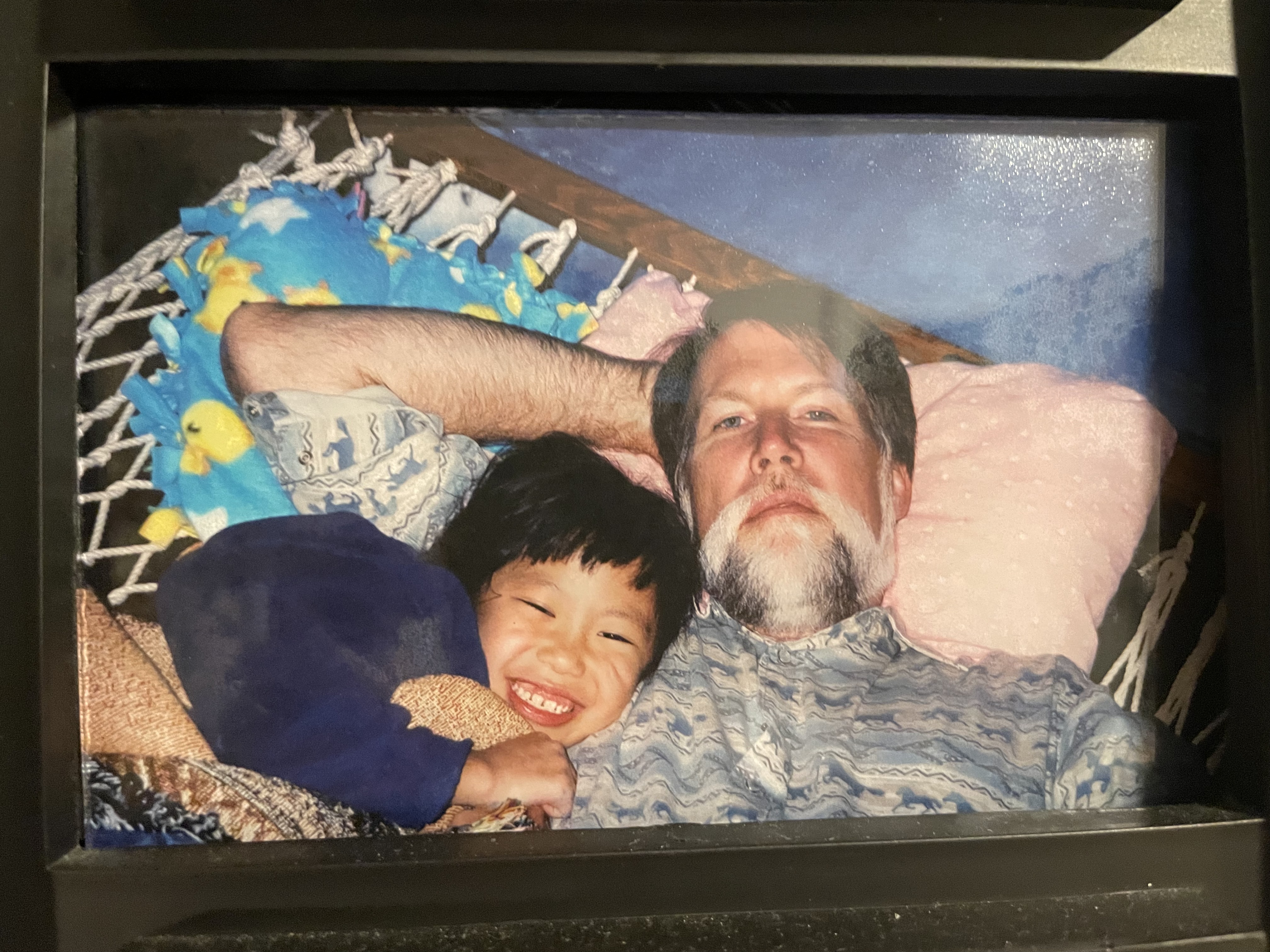
HAPPY BELATED FATHER’S DAY?
My father died on the eve of the most significant moment of my career.
I knew what had happened the second I picked up the phone—the list of reasons to call your sister at 4 am is short, after all—and the news wrenched me out of the Hail Mary launch we had been building towards. For months I had been consumed by everything that needed to be done, carried by the feeling that we were on the precipice of something. Then suddenly, stillness. Silence.
The roar of daily life faded.
In its place, I heard my sister’s voice over and over and over and over and over again.
After hanging up the phone, I mostly went about my weekend as planned. It was a normal Saturday. It wasn’t normal at all. Adding insult to injury, the sun shone across San Francisco.
I played Tetris, having read that it helped mitigate intrusive memories after traumatic events. I worried that this would change my relationship with a game I had always loved — another thing tainted.
I heard my sister’s voice. I listened to music. I heard my sister’s voice. I changed her contact photo. I heard my sister’s voice. I wondered why there aren’t more songs about dead people who weren’t great. I heard my sister’s voice. I don’t remember exactly what she said but I can still feel the space that hung right before “he died”. There’s a certain inhale you take before delivering life changing news (or maybe it’s your mind slowing down time, suspending you in ignorance for a few milliseconds more). I heard her voice.
Doctors are trained to use the words “died” or “dead” when delivering the news to families. My father was a doctor (by way of a detour through the 4th Reconnaissance Unit as a hospital corpsman) so I try to do the same. Still, the poetry of euphemism tugs at me from time to time. Left, passed, transitioned, went with God, crossed over, at rest. Gone. Died. Dead.
Our relationship was a series of closed doors.
He was full of contradictions, his capacity for genuine warmth and care seemingly at odds with the evasiveness and deceit that he used to avoid his problems. Those who met him described him as gentle, kind, caring. Those who loved him knew he lied to us often, sometimes well, sometimes not.
He didn’t fix my car or try to intimidate boyfriends. He did create opportunities for me to experience things. He let me down in ways I still struggle to articulate. He built me a treehouse. He was a physician to the end, carrying his medical license everywhere he went. Even when he struggled to recall birthdays, names, the current year, he could diagnose conditions on medical shows. A few months ago, I cried watching a TikTok of a retired pediatrician with dementia examining a baby doll.
When I see photos of him, I feel like I’m looking at a stranger. Did he feel the same way?
I didn’t lose a role model or a protector that day. Since I thought I had already grieved our relationship, the force with which the fury, pity, shame, grief, relief, panic, bleak comedy, shock had blasted through my carefully maintained walls took me by surprise. It was (is?) complicated.
“Anger is a defensive emotion,” my therapist told me once. “What do you think your body is trying to protect you from?”
In his lifetime, I could not move past the bitterness and rage I felt towards him. Nor could I ignore the reality of his deteriorating physical and mental condition. The person who had raised me was gone; so, too, was the person who had hurt me. I was terrified that he would die before I had the chance to decide what I wanted our relationship to be and, paralyzed by the magnitude of that choice, I bided my time by upholding the “distant but cordial” status quo.
I’ve been told that Enneagram 7s core motivations and fears are to maintain their freedom and avoid pain. I had a formula. It worked.
Now, with no possibility, hope, or fear that we could reconcile, the burden of our relationship was now mine to bear alone. I think I had assumed that when he died, we would be frozen in that moment and I would forever be trapped with my decision to not decide, but the distance that death created had the opposite effect. I came to understand him a little bit. I started to understand myself better, too. I was let down by him, I was loved by him, I was liberated when he left.
The hum of daily life returned.
The launch worked and over time, my company crashed through signup records, ARR milestones, and anniversaries. Every year, an ode to the moments that everything changed. Every year, a salute to the versions of me that had formed in the wake of tremendous gain and immense loss.
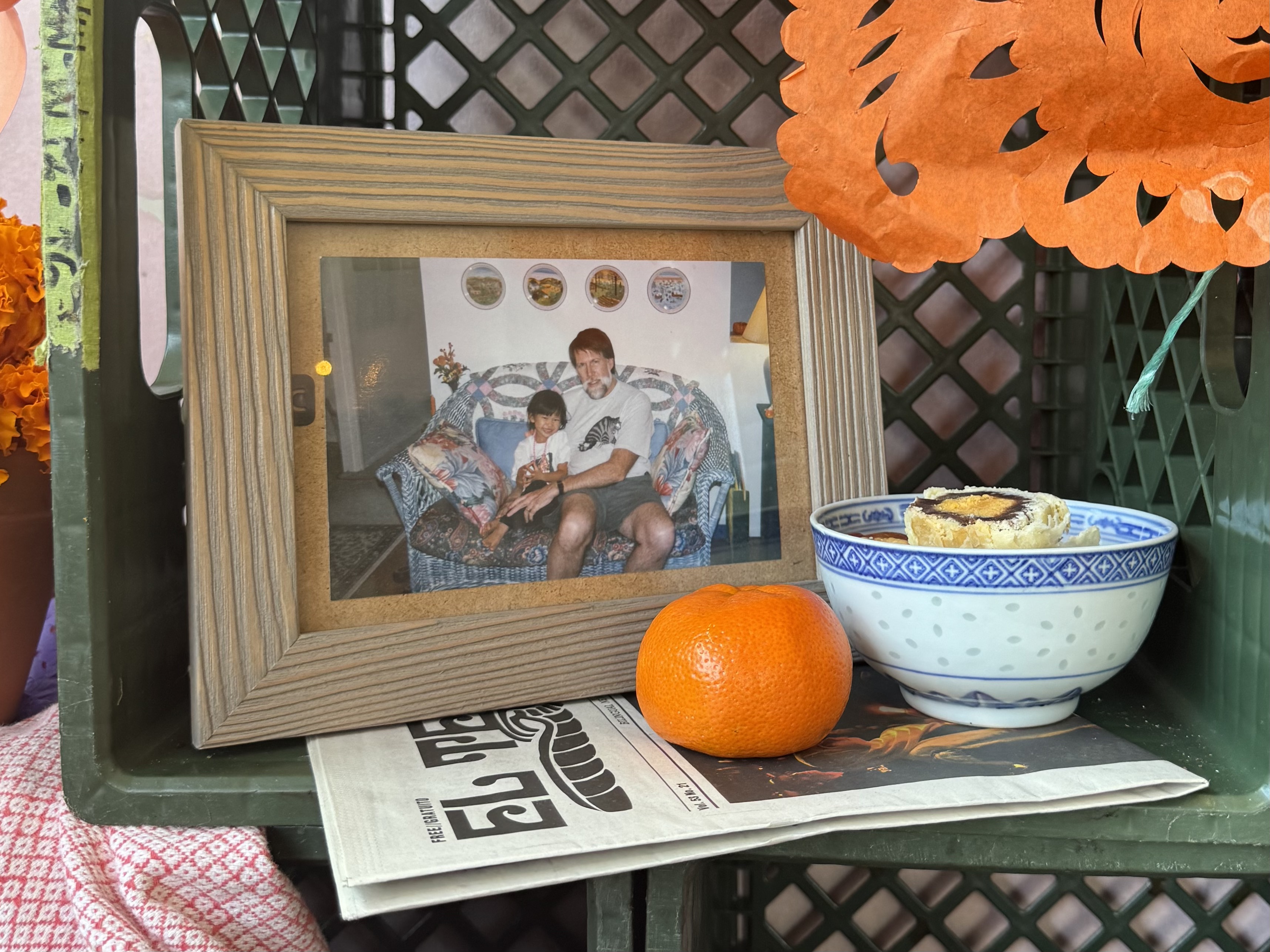
A few months after my father’s death, I added a photo of us to an ofrenda that my friends had built. Conflicted as I was about our relationship, I wasn’t sure what compelled me to do it—I didn’t want whatever piece of him might remain in the universe to find its way back to me—but still, I placed the photo on the milk crate and stepped back to take a look at it all.
Painted on the wall above, a quote from Mahmoud Darwish:
بدون أمل فقدنا
Without hope we are lost.
Year after year, I had hoped for change in him. Now, I hoped for change in myself. Outside, the sun shone through the clouds.